Mortgage Deferrals Now Recorded on Credit Reports

Sukh Sohal • August 25, 2020
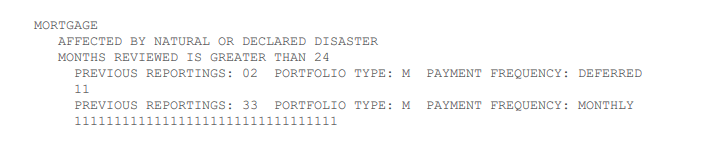
If COVID-19 has negatively impacted your finances and you're currently deferring your mortgage payments, you should know that this will be visible on your credit report. Here is an image from a recent credit report.

In this scenario, it shows that the mortgage was paid as agreed monthly for 33 months before being deferred for the last two months. It also shows that mortgage payments are currently in deferral.


Some may consider the credit bureau reporting a deferred status as good news. As COVID-19 hit like a freight train, many financial experts wondered about reporting errors on credit bureaus as a result of deferred payments. The fact that there is a system in place to report deferrals is a good sign.


Deferring your mortgage payment won't lower your credit score, but reporting errors from deferrals might. Once you've resumed your payments, it's a good idea to get a copy of your credit report to check for errors.


So, why does this matter to me now?


If you're considering a change to your mortgage, most lenders will be very hesitant to consider lending you new money when you aren't able to make your existing mortgage payments. This will be the case if you are looking to purchase a new property, renew, or refinance your current mortgage.


In fact, some lenders expect to see a history of regular repayment on any previously deferred loans before proceeding with any new application. Length of time after deferral varies by lender. This would include any debt payments (loan, line of credit, credit card) that have been deferred as well.


If changes to your mortgage are on the horizon, you need to have resumed all your regular debt payments before it will be possible to secure new mortgage financing.


If you'd like to discuss your personal financial situation with us, please contact us anytime!
604-862-8080
info@oakandprime.ca
RECENT POSTS 

By Suhk Sohal March 19, 2026
If you're a homeowner juggling multiple debts, you're not alone. Credit cards, car loans, lines of credit—it can feel like you’re paying out in every direction with no end in sight. But what if there was a smarter way to handle it? Good news: there is. And it starts with your home. Use the Equity You’ve Built to Lighten the Load Every mortgage payment you make, every bit your home appreciates—you're building equity. And that equity can be a powerful financial tool. Instead of letting high-interest debts drain your income, you can leverage your home’s equity to combine and simplify what you owe into one manageable, lower-interest payment. What Does That Look Like? This strategy is called debt consolidation , and there are a few ways to do it: Refinance your existing mortgage Access a Home Equity Line of Credit (HELOC) Take out a second mortgage Each option has its own pros and cons, and the right one depends on your situation. That’s where I come in—we’ll look at the numbers together and choose the best path forward. What Can You Consolidate? You can roll most types of consumer debt into your mortgage, including: Credit cards Personal loans Payday loans Car loans Unsecured lines of credit Student loans These types of debts often come with sky-high interest rates. When you consolidate them into a mortgage—secured by your home—you can typically access much lower rates, freeing up cash flow and reducing financial stress. Why This Works Debt consolidation through your mortgage offers: Lower interest rates (often significantly lower than credit cards or payday loans) One simple monthly payment Potential for faster repayment Improved cash flow And if your mortgage allows prepayment privileges—like lump-sum payments or increased monthly payments—those features can help you pay everything off even faster. Smart Strategy, Not Just a Quick Fix This isn’t just about lowering your monthly bills (although that’s a major perk). It’s about restructuring your finances in a way that’s sustainable, efficient, and empowering. Instead of feeling like you're constantly catching up, you can create a plan to move forward with confidence—and even start saving again. Here’s What the Process Looks Like: Review your current debts and cash flow Assess how much equity you’ve built in your home Explore consolidation options that fit your goals Create a personalized plan to streamline your payments and reduce overall costs Ready to Regain Control? If your debts are holding you back and you're ready to use the equity you've worked hard to build, let's talk. There’s no pressure—just a practical conversation about your options and how to move toward a more flexible, debt-free future. Reach out today. I’m here to help you make the most of what you already have.
By Suhk Sohal March 18, 2026
The Bank of Canada announced today that it is holding its target for the overnight rate at 2.25%, with the Bank Rate at 2.5% and the deposit rate at 2.20%. For anyone watching the mortgage market — whether you're renewing, purchasing, or simply keeping an eye on borrowing costs — here's a breakdown of what was announced and what it may mean for you.